Developer portal
A service catalogue, TechDocs, API docs, search and live Kubernetes state, with your brand's plugin set, decided in config rather than in a build.
A complete IDP, carrying your name, your colours and your engineering standards: developer portal, GitOps delivery, a Kubernetes control plane, identity, guardrails and observability. One container image serves every brand you run, so the tenth costs what the second did.
Access is granted team by team: no download, no public repository. In private beta.
make up to a running platform, on a laptop with Docker (8 GiB), kind and Node already on it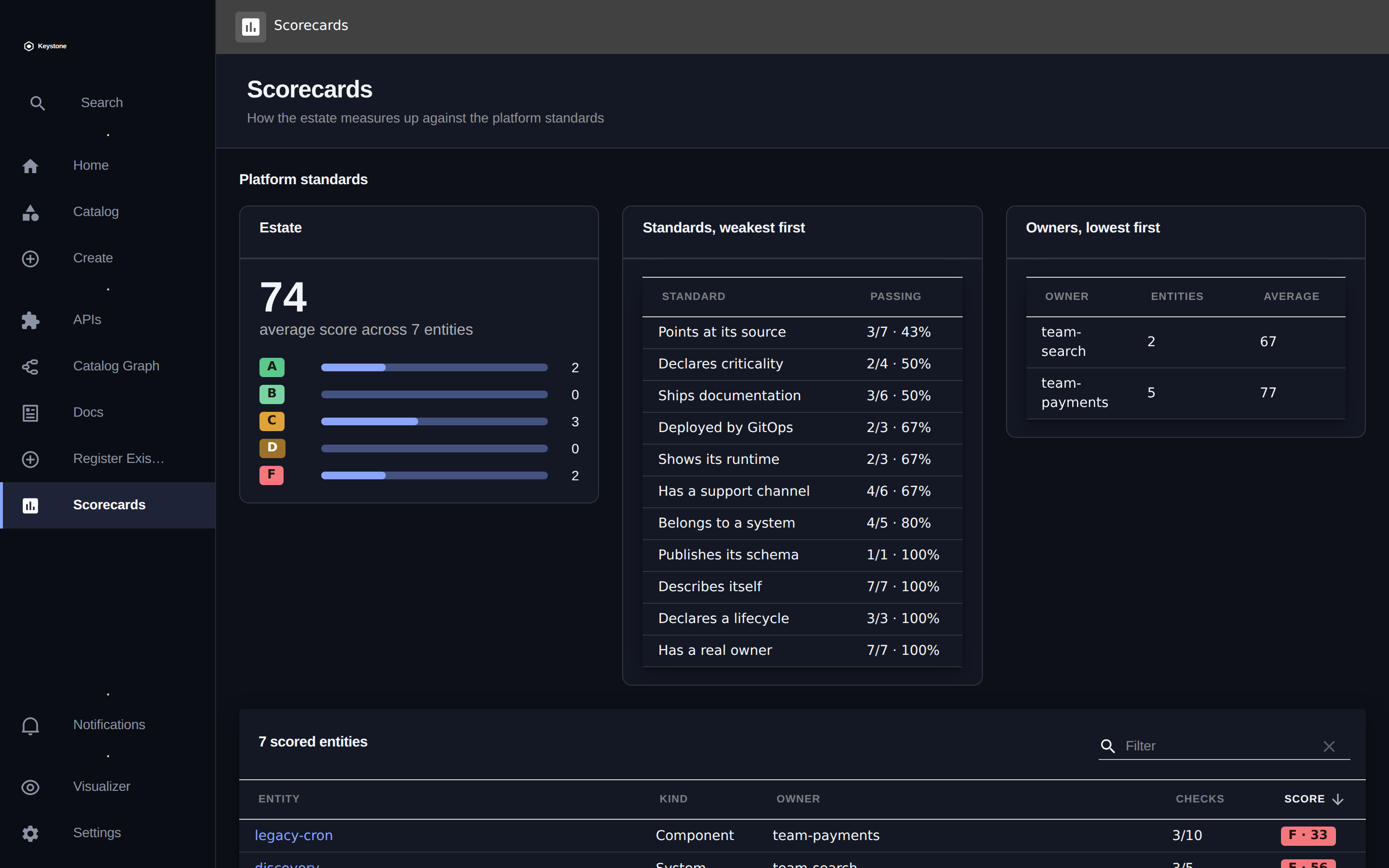
Screenshots on this page are the real product, captured from a running instance. Nothing here is a mockup.
What your customers get
Most "IDP" products stop at a catalogue. This one ships the machinery underneath: what actually deploys, what actually provisions, what stops a team doing something they should not, and what proves any of it happened.
A service catalogue, TechDocs, API docs, search and live Kubernetes state, with your brand's plugin set, decided in config rather than in a build.
Argo CD, app-of-apps, sync waves. Git is the only way into the cluster, including the control plane's own configuration, so drift is a diff, not an incident.
Crossplane, with your own API on top of it. Onboarding a team is one object; offboarding is deleting it. Cloud resources are the same claim pointed at a different provider.
Kyverno at admission and Pod Security enforced by the API server itself. Ownership labels, pinned images, resource limits, a registry allowlist, and tests proving each rule does what it says.
Keycloak groups authorise the namespace, the delivery project and the portal. Add a team in one place; there is no second list to drift out of step.
Every service graded against your engineering standards, with the remedy for each failure on the page the owner is already looking at. Each brand decides what "good" means.
The white label
Two brands below. Different name, palette, typography, hostnames, identity realm, logo, plugin set and engineering standards, running the same container image, from one configuration file. Switch this page and the screenshots at the same time:
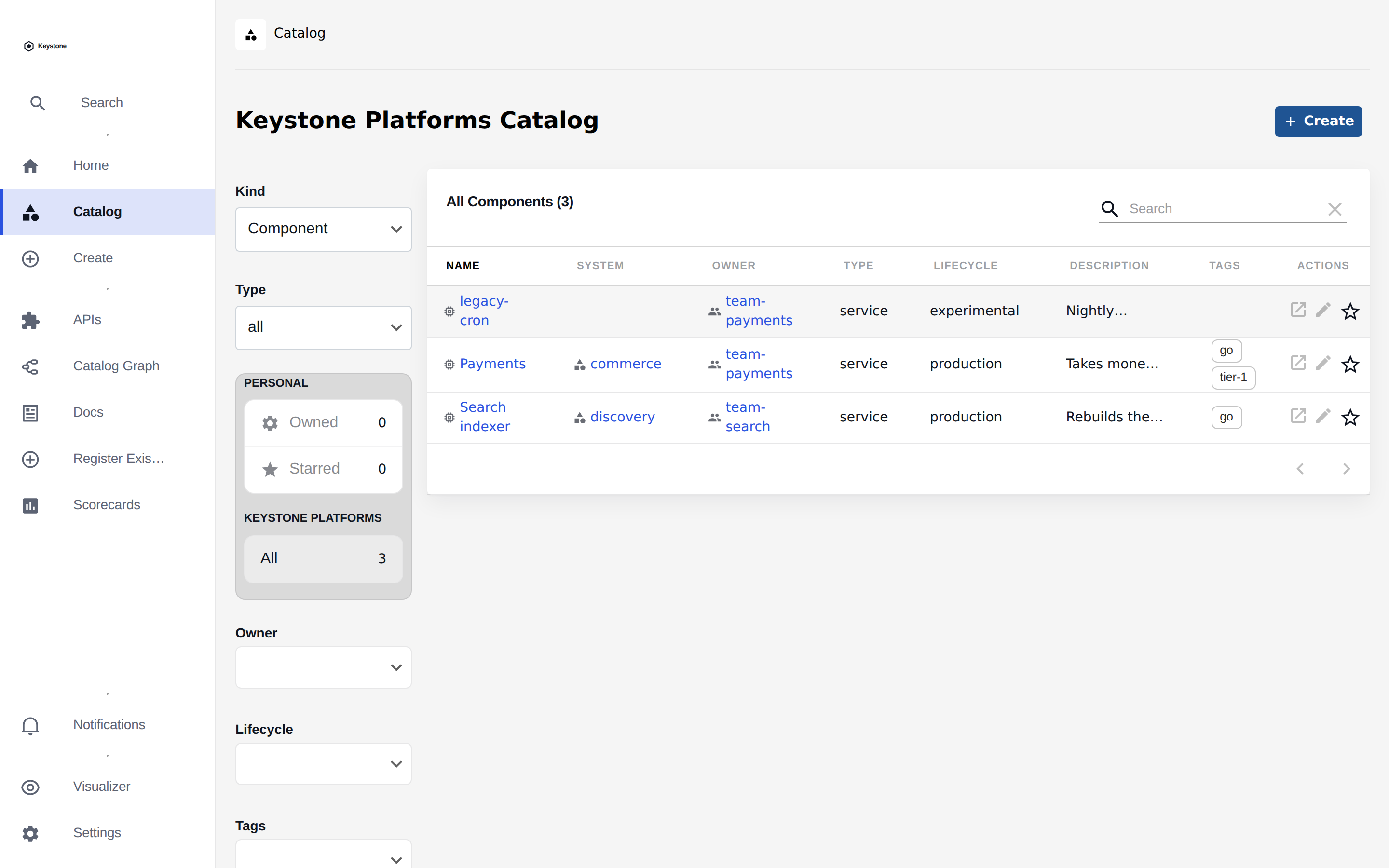
The catalogue: brand name, palette and rail all follow the config.
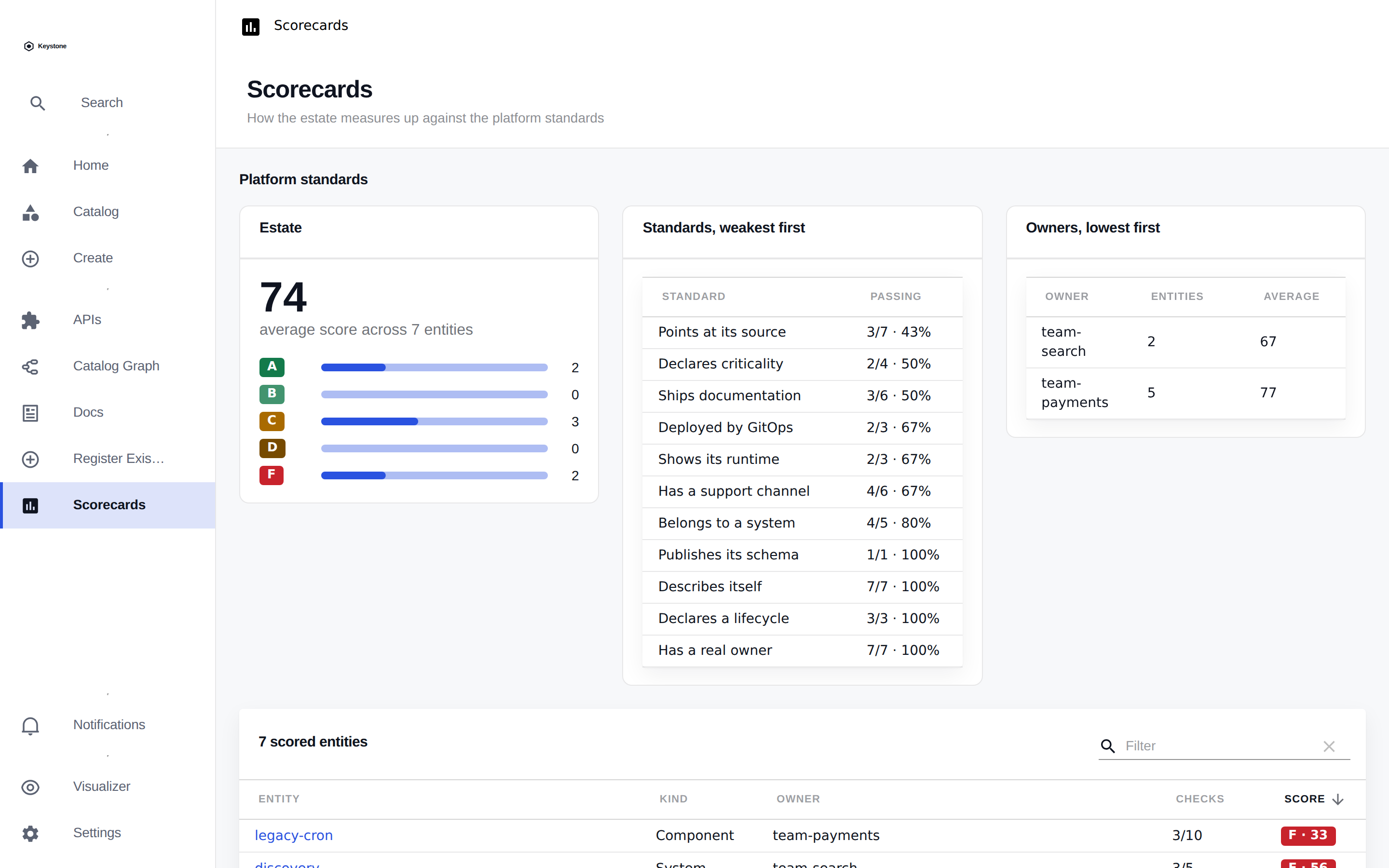
Look at the standards, not just the colours: Acme weights documentation and GitOps higher, drops criticality, and uses its own annotation namespace, so the same estate scores differently.
One file per brand, and a pod restart. No rebuild, no release, no second image to scan and ship. The portal reads its brand as it renders, so the tenth brand costs what the second did.
The renderer refuses a brand that would break: a colour that is not a colour, a plugin the build does not ship, a standard that does not exist. You find out at render time, not from a customer.
Inside the product
The live demo is the portal itself, the same build these screenshots came from, over a catalogue that is not yours. Sign in as a guest and walk a golden path; it is wired to nothing, so it creates nothing.
The estate at a glance. Everything sorts worst-first, because the page is a work queue.
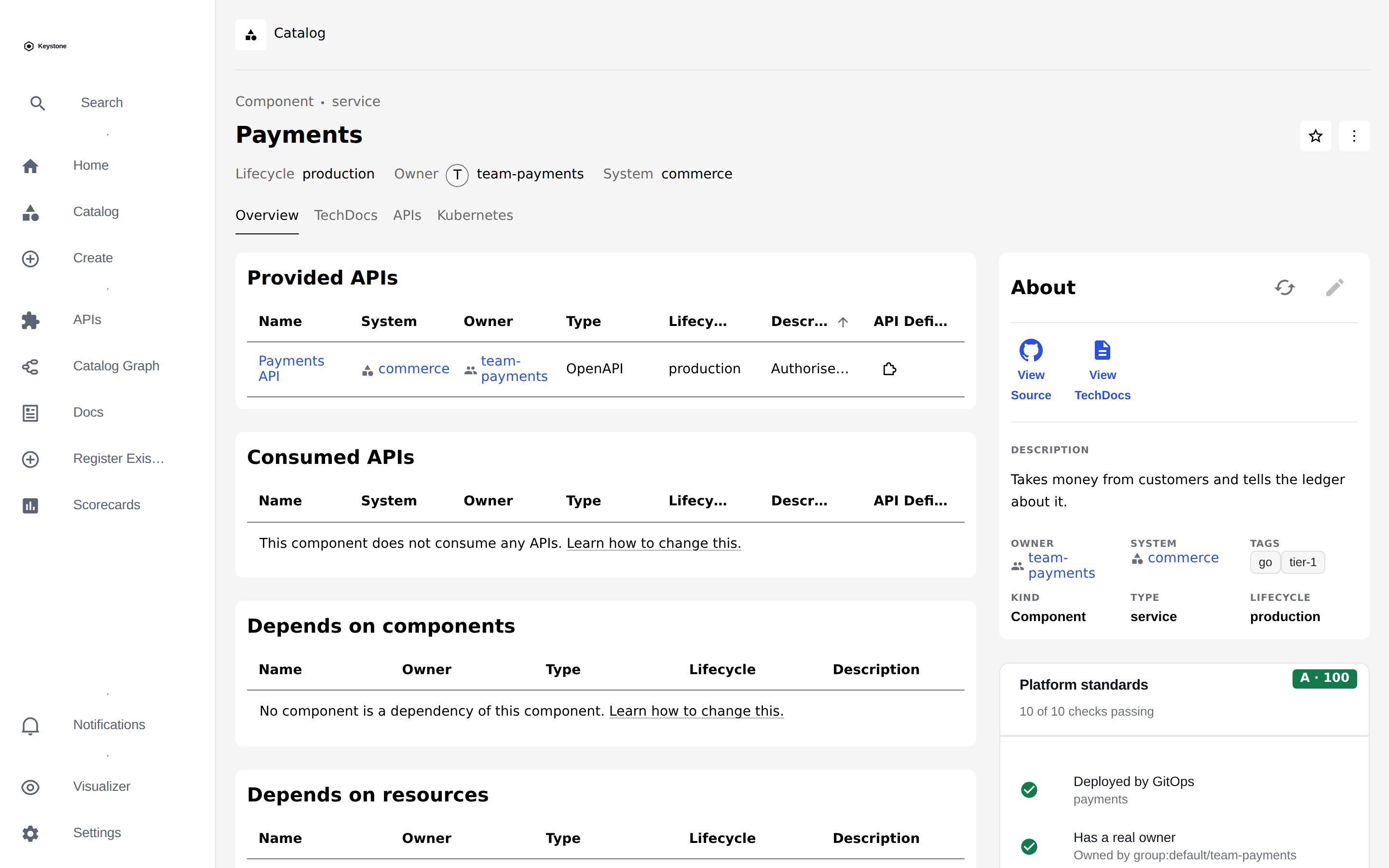
A service page: ownership, APIs, runtime, and its standards score with the remedy for anything failing.
Everything the platform knows about, filtered by kind, owner, lifecycle and tag.
Both themes are designed, not inverted, and both come from the brand's own palette.
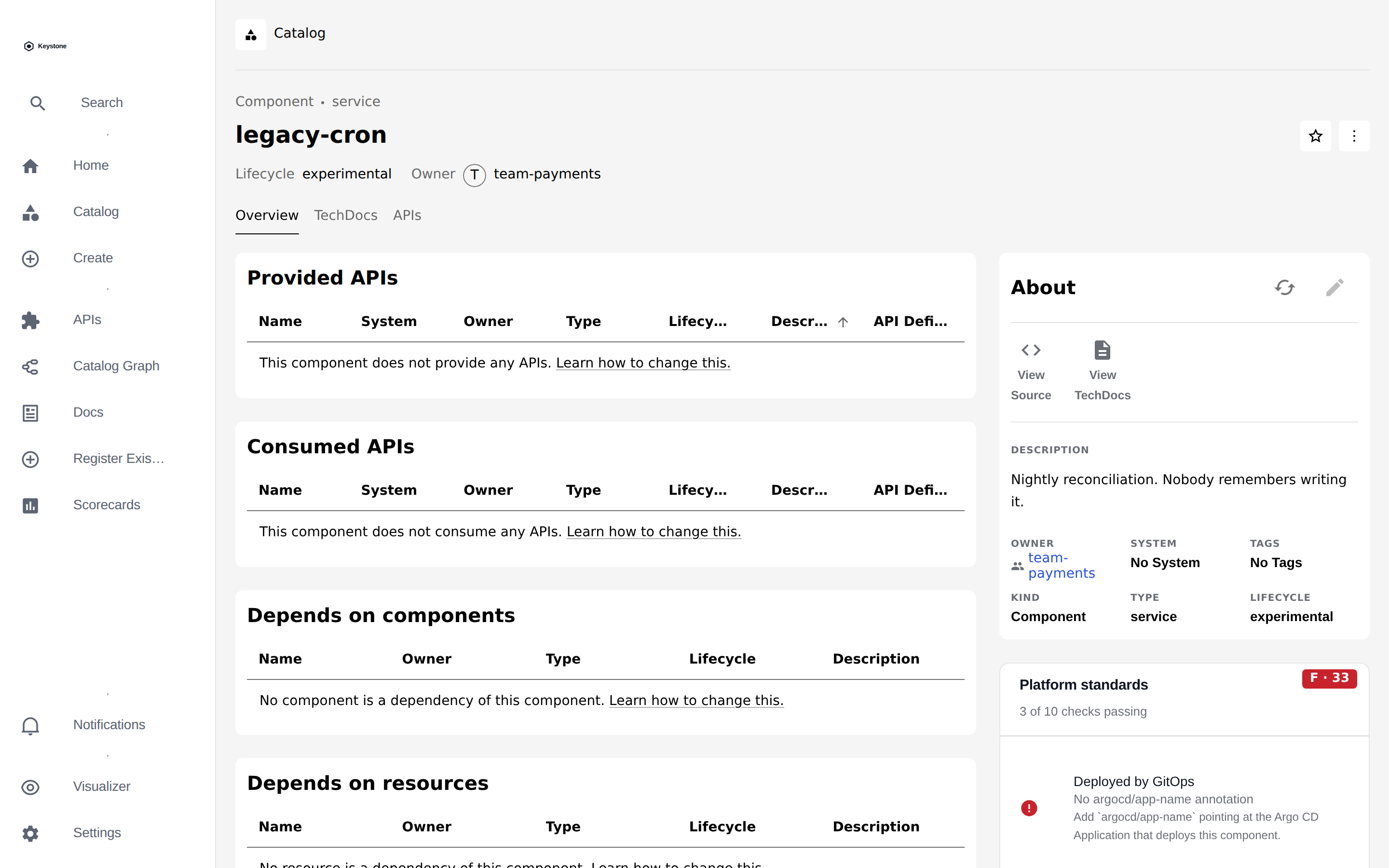
A service nobody has looked after, and exactly what to do about it.
Who it is for
Platform team
A scale-up with forty engineers, a half-finished Backstage, Argo CD somebody set up, and no consistent way to give a team a namespace.
Consultancy · MSP
You deliver Kubernetes work for several clients and rebuild the same scaffolding each time, unbilled.
Regulated enterprise
Bank, insurer, health: every control needs evidence and every change needs a reviewer.
Group IT
A group with autonomous divisions that will not accept a shared tool wearing another division's name.
How it lands
The platform stands itself up on a laptop first, so your team can see all of it working before any decision about clusters is made.
One command builds a full cluster on a laptop: portal, delivery, control plane, identity, guardrails, observability. No cluster of your own needed to see all of it.
Copy a brand file, set your colours, hostnames, plugin set and standards. Render, review the diff, and the portal is yours.
The same manifests target your environments. Identity moves to your IdP; secrets move to your vault.
One object per team. Quota, network policy, RBAC, delivery project and secret store, created and kept in step by the control plane.
Private beta
Paved is in private beta. Request access and you will hear when there is a seat.
Questions we are asked
No. There is no public repository and no download. During the private beta, access to the platform and the brand pipeline is given team by team, so each one gets a working session and a named contact.
Paved is in private beta. There is nothing to sign up to beyond the form at the bottom of this page.
Backstage, Argo CD, Crossplane, Kyverno, Keycloak, OpenBao and Prometheus are all excellent. What Paved adds is the part nobody hands you: the white-label engine, the platform API that makes a tenant one object, the standards engine, the guardrails with their tests, the identity model that ties all three together, and the upgrade path that keeps that assembly working as each project moves.
Nothing switches off by itself. There is no licence server, no phone-home and no kill switch, so the clusters keep running exactly as they are. Before anything about the beta changes, every team in it hears about it first, in writing.
Yes. Every upstream version is pinned in one file, the images are mirrorable into your registry, and the platform makes no outbound calls of its own. The portal loads no third-party fonts, scripts or analytics.
Entirely in your clusters. We never receive your catalogue, your source, your users or your metrics.
Beta teams get the source. Brands, plugin sets and standards are configuration; golden paths and compositions are yours to write. Changes you make to shared code are supported on a best-effort basis, and we will tell you honestly which ones will make upgrades harder.
Any conformant cluster from 1.28: EKS, GKE, AKS, OpenShift, Rancher, or bare metal. The default control plane provisions in-cluster resources only, so it needs no cloud credentials; cloud provisioning is an additional provider behind the same API your developers already use.
Tell us a little about your estate and we will write back, usually within a few days, when there is a seat. It stands itself up on a laptop, so trying it costs your team an afternoon rather than a project.
Join the private beta
Built, running, and opened to a handful of teams at a time so each one gets a working session and a named contact.
Every answer below tells us something we cannot find out any other way.